How far would you go to protect what you love? This timeless question reverberates through Troy, Tom Wright’s latest reimagining of Greek myth, directed with haunting precision by Ian Michael. What unfolds is less a play than an act of ritual—an unflinching meditation on sacrifice, love, and the endless cycle of violence that defined both the age of myth and, unsettlingly, our own.

From the moment the audience steps into the transformed theatre, Dann Barber’s set design positions us within a space of reverence and dread. The environment feels alive with history, danger, and inevitability. Paul Jackson’s lighting carves the stage into tableaux of intimacy and war, while Rosalind Hall’s composition weaves in a sonic landscape that feels both ancient and unnervingly modern. Whispers of wind that could be the gods themselves. Marco Cher’s sound design amplifies these textures, so that even silence becomes suffocating.
Wright’s writing is as poetic as it is brutal, pulling language from the marrow of myth and shaping it into something both archaic and startlingly contemporary. Each character is less a singular figure than an echo chamber of many voices, embodying the collective pain of a civilisation caught in the machinery of fate. This dramaturgical choice allows the cast to shift between roles with fluidity, creating a chorus-like effect that underscores the timelessness of the story.

The performances are uniformly extraordinary, but several demand particular mention. Paula Arundell’s Hecuba is a force of unrelenting grief and steel, her every word weighted with centuries of maternal suffering. Geraldine Hakewill’s Clytemnestra simmers with restrained fury, every gesture measured as though she is already planning her inevitable vengeance. Danny Ball brings to Achilles a blend of arrogance and vulnerability, revealing the fragility of a man both blessed and cursed by divine proximity. Elizabeth Blackmore’s Cassandra is a revelation—her prophecies delivered with a fractured, electric intensity that feels almost unbearable in its desperation.
Lyndon Watts, while embodying Patroclus with quiet strength, becomes most unforgettable when lending his voice to the production’s soundscape. His vocals—eerily haunting, disembodied, and almost divine—rise above the action like an invocation. Not tethered to a single character, his singing exists in another realm, as though the gods themselves were breathing through him. It is a voice that does not merely accompany the production but transcends it, piercing the theatre with a lament that lingers long after the lights fade.

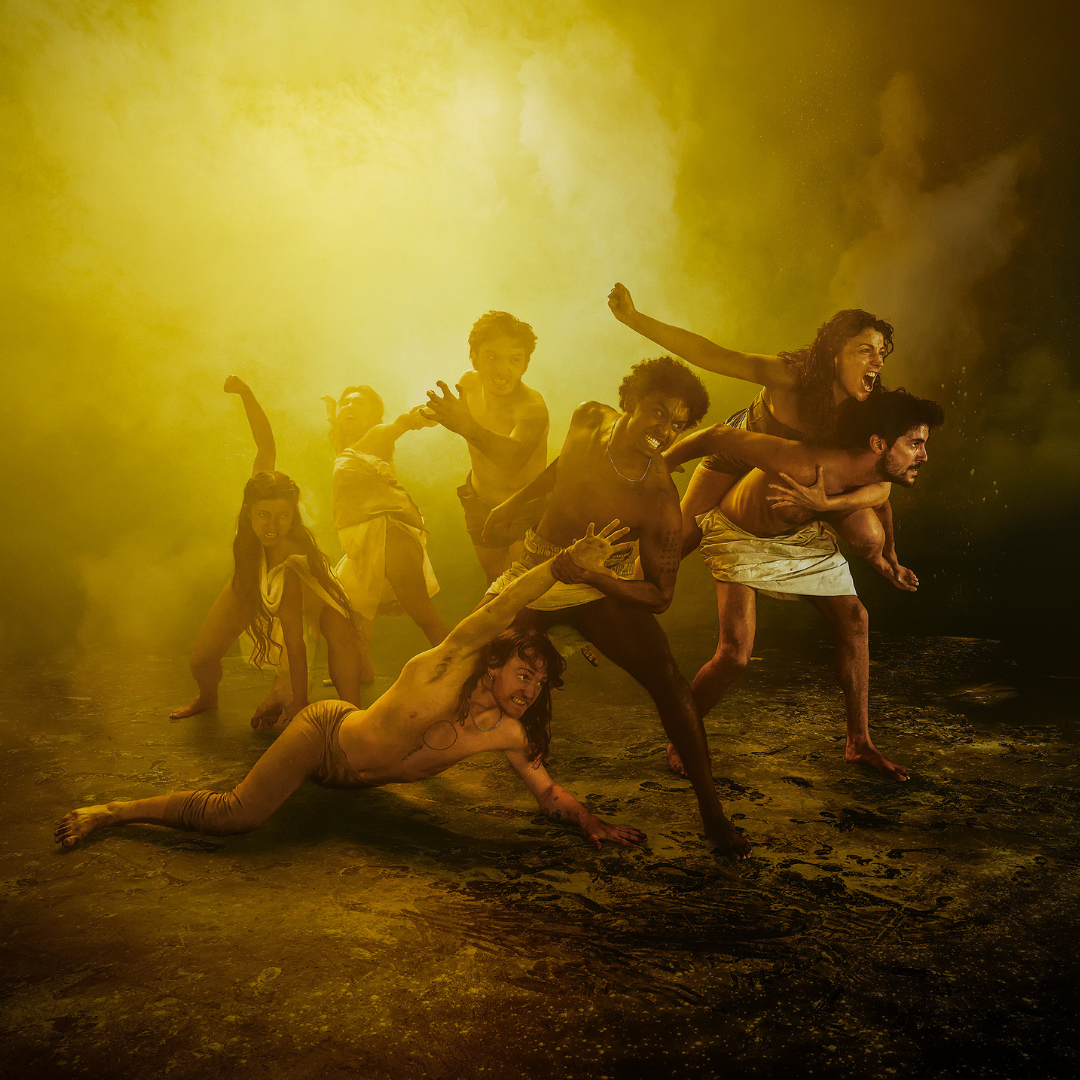
Ian Michael’s direction binds all of this into a tapestry of movement, sound, and stillness. Under the choreography of fight and movement director Lyndall Grant, the ensemble’s physicality borders on ritualistic, each gesture laden with symbolic weight. The battle scenes are visceral yet stylised, embodying the horror of violence without reducing it to spectacle.

Troy is not a retelling of myth—it is an invocation. It compels its audience to listen to the screams buried beneath the sands of legend, to witness the human cost of glory, conquest, and divine cruelty. It is the theatrical event of the season: brutal, beautiful, and unforgettable.